23 July, 2007
12 July, 2007
Hartig Home
07 July, 2007
cat people songs
me and my bro

Me and My Brother
by Ed Halter
Village Voice, November 7th, 2006
A heady intermingling of documentary and fiction, photographer Robert Frank's first feature (finished in 1969, then re-edited by Frank in 1997) focuses on poet Peter Orlovsky's schizophrenic brother Julius, portrayed at first in person via footage of the siblings in New York and touring the country with Allen Ginsberg, then entwined with re-enacted scenarios of actors playing the brothers and their acquaintances. Taking it a few notches more meta, the director also includes scenes of himself casting the actor who will play Julius‹only Frank is portrayed by a smooth-faced, young Christopher Walken. Peppered with smudgy urban boho romps and psycho-philosophical musings, the film fits squarely between Frank's Pull My Daisy and the painfully truthful revelations of his later video diaries. For despite its hypercubic narrative and high-modernist reflexivity, Me and My Brother offers a tangibly emotional experience as it struggles poignantly with the limits of understanding another person's mind.
27 June, 2007
a cat among animals

"If I were a tree among trees, a cat among animals, this life would have a meaning, or rather this problem would not arise, for I should belong to this world. I should be this world to which I am now opposed by my whole consciousness and my whole insistence upon familiarity. This ridiculous reason is what sets me in opposition to all creation. I cannot cross it out with a stroke of a pen."
- Albert Camus
21 June, 2007
So here I am
So here I am, in the middle way, having had twenty years -
Twenty years largely wasted, the years of l'entre deux guerres -
Trying to use words, and every attempt
Is a wholly new start, and a different kind of failure
Because one has only learnt to get the better of words
For the thing one no longer has to say, or the way in which
One is no longer disposed to say it. And so each venture
Is a new beginning, a raid on the inarticulate,
With shabby equipment always deteriorating
In the general mess of imprecision of feeling,
Undisciplined squads of emotion. And what there is to conquer
By strength and submission, has already been discovered
Once or twice, or several times, by men whom one cannot hope
To emulate - but there is no competition -
There is only the fight to recover what has been lost
And found and lost again and again: and now, under conditions
That seem unpropitious. But perhaps neither gain nor loss.
For us, there is only the trying. The rest is not our
business.
- T. S. Eliot
Twenty years largely wasted, the years of l'entre deux guerres -
Trying to use words, and every attempt
Is a wholly new start, and a different kind of failure
Because one has only learnt to get the better of words
For the thing one no longer has to say, or the way in which
One is no longer disposed to say it. And so each venture
Is a new beginning, a raid on the inarticulate,
With shabby equipment always deteriorating
In the general mess of imprecision of feeling,
Undisciplined squads of emotion. And what there is to conquer
By strength and submission, has already been discovered
Once or twice, or several times, by men whom one cannot hope
To emulate - but there is no competition -
There is only the fight to recover what has been lost
And found and lost again and again: and now, under conditions
That seem unpropitious. But perhaps neither gain nor loss.
For us, there is only the trying. The rest is not our
business.
- T. S. Eliot
Doherty Diaries
3am, 31st Jan 2007
And onwards, through time & these sterile corridors of the clinic you follow me. 36 hours in and not much to show in the way of withdrawals (only vomiting though that may have been the final line of sticky sparkling gak that I had concealed in my pillow) foolishly before the very dawn.
I now surrender to the science of detoxification and pray that Godspeeds the worst of it and Saturday morning at the latest will see me once more in my love’s loving arms. We have been close this time that passed and with the smack and needle free we shall marry in the summer and I become ten times happier than any given smackhead. Huzzah!
Doherty Diaries
I have been informed that my behaviour reached an all time low during the recent visit to Thailand . . .after deportation I was thinking along the lines of being single. Folly such a thought, my heart aching & swimming & I dearly missing Kate despite being convinced that the relationship was an unbearable & intolerable disaster. However influential my raging drug addiction upon matters is not really up for debate but still I found myself incapable of justifying all the pain & general disfunction of much of the affair. And so I flee/am booted out . . . part of me retains a contradictory belief that I can learn from the shame & strain of my awfulness & become a better man by default. There’s hope for us all, right? why not.
I have been banging up I confess, and yet my use is extremely moderate and controlled what am I saying? Kate will not tolerate this shite I wouldn’t blame her, and alongside the fixing neither of us seem to completely trust each other although I love her and no other and the tiffs & tumults come between magical happy times. the most cherished hours are those spent in her arms . . . so why this suspended feud? oh I dunno, she certainly knows how to get a rise out of me. Or tears. Or low-flying guitars. Is it me trying to avoid the reality of my most antisocial habits, or is there any defence in these debates that I can confidently use. . . and so I sorry selfish c*** I might well be . . .
It is divinity itself, true love, and hell is the heart’s terrible palpitations as a “turning” is in the offing. All I wish for is for her to come and lead me back out of the dark.
3pm, 29th Jan 2007
So there’s a silent pop as I find the vein & launch a great shift into my system. Eye-closing, jaw tightening speedballing through the opening hours of my detox at the Nightingale Hospital, Lisson Grove. It begins now, does the rest of my life.
I have been banging up I confess, and yet my use is extremely moderate and controlled what am I saying? Kate will not tolerate this shite I wouldn’t blame her, and alongside the fixing neither of us seem to completely trust each other although I love her and no other and the tiffs & tumults come between magical happy times. the most cherished hours are those spent in her arms . . . so why this suspended feud? oh I dunno, she certainly knows how to get a rise out of me. Or tears. Or low-flying guitars. Is it me trying to avoid the reality of my most antisocial habits, or is there any defence in these debates that I can confidently use. . . and so I sorry selfish c*** I might well be . . .
It is divinity itself, true love, and hell is the heart’s terrible palpitations as a “turning” is in the offing. All I wish for is for her to come and lead me back out of the dark.
3pm, 29th Jan 2007
So there’s a silent pop as I find the vein & launch a great shift into my system. Eye-closing, jaw tightening speedballing through the opening hours of my detox at the Nightingale Hospital, Lisson Grove. It begins now, does the rest of my life.
Doherty Diaries
Written while staying in Kate’s country house in the Cotswolds
Never seen anything like it in my life she’s amazing dancing rolling her shoulders in her cut up dress I’m so wrong I know but if she loves me I’ll scream with joy an eternity of shy shadows glancing at myself I could cry for numbness but my days I’m prone to believe and watching her dance to Ike & Tina Rivers Deep Mountains High is all that matters and all that will ever.
02 June, 2007
Rush'N'Disco
Portland performance crafters Rush-N-Disco Live
Monday June 4th
EL Cid
4212 W Sunset Blvd
Los Angeles, CA 90029
(323)668-0318
Tuesday June 5th
Tangier
2138 Hillhurst Avenue
Los Angeles, CA 90027
(323)666-8666
Monday June 4th
EL Cid
4212 W Sunset Blvd
Los Angeles, CA 90029
(323)668-0318
Tuesday June 5th
Tangier
2138 Hillhurst Avenue
Los Angeles, CA 90027
(323)666-8666
01 June, 2007
Karen Kilimnik
The Institute of Contemporary Art is pleased to present the first American survey for Karen Kilimnik (b. 1957, Philadelphia). Drawing correspondences between romantic tradition and consumer culture, Kilimnik's work brings a haunting and contrary sense of beauty to contemporary art. The world of the ballet and childhood, romantic painting and pop music, icons of film and fashion, signs of witchcraft, time-travel, and murder comprise an imagery that has been culled from the historic and recent past into an unsettling present. In a world where the forces of nature, youth, and terror, have taken awesome hold, Kilimnik's art rematerializes a quest for the romantic sublime.

Occupying both the ICA's main gallery spaces, the survey was selected by the curator with the artist, who typically approaches the exhibition of her work as a form of theatrical mis-en-scene. For this installation, Kilimnik specified the first floor galleries appear almost empty except for a discrete chamber where her paintings are installed salon style on red walls—a romantic museum framed by the modern architecture. This exhibition spans fifteen years of painting, drawings, assemblage sculptures, installation, photographs and video. Curated by Ingrid Schaffner, ICA Senior Curator, this exhibition is accompanied by a catalog publication and will be on view April 20 - August 5, 2007.


Occupying both the ICA's main gallery spaces, the survey was selected by the curator with the artist, who typically approaches the exhibition of her work as a form of theatrical mis-en-scene. For this installation, Kilimnik specified the first floor galleries appear almost empty except for a discrete chamber where her paintings are installed salon style on red walls—a romantic museum framed by the modern architecture. This exhibition spans fifteen years of painting, drawings, assemblage sculptures, installation, photographs and video. Curated by Ingrid Schaffner, ICA Senior Curator, this exhibition is accompanied by a catalog publication and will be on view April 20 - August 5, 2007.


Come Alive!
"Love the moment.Flowers grow out of dark moments. Therefor, each moment is vital. It affects the whole. Life is a succession of such moments and to live each, is to succeed."

Come Alive!
by Sister Corita Kent
available at
The Corita Art Center,
Immaculate Heart Community,
5515 Franklin Avenue.
Los Angeles, Ca 90028

Come Alive!
by Sister Corita Kent
available at
The Corita Art Center,
Immaculate Heart Community,
5515 Franklin Avenue.
Los Angeles, Ca 90028
31 May, 2007
Summer reading
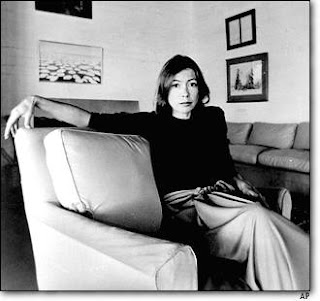
| j o a n d i d i o n |
BY DAVE EGGERS
Joan Didion's new novel, "The Last Thing He Wanted," is her first in 12 years. Set in 1984, it centers on Elena McMahon, an American journalist who gets tangled up in the covert sales of American arms in Central America. It is sparely written and tightly plotted and fiercely intelligent — all the sorts of things we've come to expect from Didion.
Some things that you probably know but if not will be helpful in enjoying this interview:
* Didion is married to John Gregory Dunne, and has been for a long time. When she says "we," he makes "we."
* Though she no longer writes the sort of personal-social essays that made up books like "The White Album" and "Slouching Towards Bethlehem," she still contributes journalism and critical essays to magazines like The New Yorker and The New York Review of Books.
* In person she is very small. She is also graceful, personable, warm and funny.
With "The Last Thing He Wanted," I read that you weren't sure how it was going to turn out until you were finished with it.
No, no I wasn't. I wanted to do a very, very tight plot, just a single thread — you wouldn't even see the thread and then when you pulled it at the end everything would fall into place. That was the intention there. But you would go mad if you tried to plot that closely ahead of time. So essentially what you have to do, I found, is you have to make it up every day as you go along. And then you have to play the cards you already have on the table — you have to deal with what you've already said. Quite often, you've got yourself into things that seem to lead nowhere, but if you force yourself to deal with them, that was the discipline of it.
For example, one of the first things I had started with in this book was the idea of this woman walking off a campaign. Because I'd covered some campaigns in '88 and '92, I wanted to use some of that sense of a campaign. So then, I didn't know, then she would go to Miami to see her father. Then, I couldn't figure out where she'd been. Then I decided she ought to be from Los Angeles and had been married to someone in the oil business. That kind of gave me a fresh start. But then I was having to get her from Los Angeles to being a political reporter, right? It was a really hard thing to do. It was also a lot of fun.
There were certain chapters where it does sound like you're starting from scratch almost, when you start hearing about Elena's dreams, for example.
Yeah, I mean, I was just sitting there wondering what I could do that day. Sometimes, also, you just feel it's right to step back from it a little bit. Otherwise it's going to get linear, "and then she said, and then she did..." It doesn't keep you awake to write it.
while your fiction seems to be getting increasingly lean, your essays seem to be moving in the opposite direction.
They're getting denser and denser. There's a whole lot of stuff going on in a piece — you're trying to think it through. Generally, you think about a question or a situation in a more complex way than you would make a scene. Novels are almost like music or poetry — they just come to me in simple sentences, whereas I think my pieces get more and more complex ever since I've started using a computer.
What do you use?
I use an IBM Thinkpad. I just use it like a typewriter, but when I started using it in 1987, I thought I won't be able to write anymore, so I thought I'd go back to the typewriter. But you couldn't go back to the typewriter after using the computer, so finally after about a month I got proficient enough that I could actually work on it without being distracted by it, and in fact then it started making me a whole lot more logical than I ever had been. Because the computer was so logical, it was always right, I was wrong ... and the time saved.
Before I started working on a computer, writing a piece would be like making something up every day, taking the material and never quite knowing where you were going to go next with the material. With a computer it was less like painting and more like sculpture, where you start with a block of something and then start shaping it.
You feel like it's just there ...
It's just there, and sometimes you'll find yourself — you get one paragraph partly right, and then you'll go back and work on the other part. It's a different thing.
Your work feels like it was written by a slow writer. I mean that in the best possible way.
Over the course of several years I had false starts on this novel several times. I couldn't get anywhere with it. Then I had this block of time last fall from the end of August until Christmas, so I just decided I would try to finish it in that period. So I went back and I started, and I did finish it about Christmas time, but that was about as fast as I could work. And a lot of it turned out to already be done in note form to hang together. So this was just running it through with the thread.
There is a character in the book named Bob Weir. Are you a Grateful Dead fan?
[laughs] No, that is where that name comes from, isn't it? I had totally forgotten that. No, I had no idea, I knew there was something just right about that name.
Elena resembles, in certain ways, some of your other characters from some of your other novels, in that she finds herself in the middle of this huge life change, and it's seemingly irreversible, and yet she goes with it. What does that pattern mean to you?
I don't know, it's nothing I want to examine too closely. Every time I do it, I think it's brand new. It comes to me in a flash! [laughs] It would certainly make things easier if I remembered, but it's — I guess all novels are dreams of what might happen or dreams of what you don't want to happen. When you're working on them, it's very much like a dream you're moving in. So, to some extent, obviously, the same characters are going to keep populating your dreams.
Have you ever done something like Elena does here — walked off a campaign, reinvented youself?
Not really, no. But you can see the possibility, it's something you might be afraid of happening. It's definitely something you don't want to happen. I don't want to happen. That's what I would take from it.
I read somewhere that you identified yourself as a libertarian.
I was explaining to somebody what kind of Republican I had been. That was essentially why I had been feeling estranged from the Republican Party per se, because my whole point of view had been libertarian. I mean, I wouldn't call it totally "on the program" libertarian.
You don't vote the ticket?
[laugh] No ... I think the attraction was that it was totally free. It was totally based on individual rights, which, as a Westerner, I was responsive to. Then I started realizing there was a lot of ambiguity in the West's belief that it had a stronghold on rugged individualism, since basically it was created by the federal government. So I haven't come to any hard conclusion, here.
Are you watching the campaign? What do you think of Clinton?
Well, he's the luckiest man alive, isn't he? He seems to be lucky, which I guess in a lot of cultures has been what people wanted. Luck had a kind of totemic power, that made you the leader.
I read your review of Bob Woodward's "The Choice," in The New York Review of Books. It seemed that his lengthy descriptions of his reporterly methods got under your skin.
Yes. There's a certain kind of reporting of a book that when you're casually reading through you think you've missed something, you're not informed here, you've totally missed the point, there must be something more to this than meets the eye. So then I started reading "The Choice" and I had been actually following the campaign in a way until then, so I did know something about it, and I thought, what's going on here? There's nothing here we don't know. And even then, I would sort of doze off every now and then and think "I must be missing this — there must be more to this than I'm finding."
You and your husband wrote the screenplay for "Up Close and Personal." How do you think it turned out?
Well, it turned out — from the beginning, what it was supposed to be was a vehicle for two movie stars, and that's what it was.
You have no illusions, it seems, about the Hollywood game.
Well, if you don't know how to play it you shouldn't be in it. It's always sort of amused me.
I just read an interview with Charles Schultz, the creator of Peanuts. He's a billionaire, of course, and he was asked what his idea of success was — if he considered himself "successful." He said something like, "Yes, because now I feel like I can go into any bookstore, and if I see a book I really like, I can buy it." I thought that was really beautiful. Do you consider yourself successful?
I never feel particularly successful. I always feel like I've not quite done it right, that I ought to be doing better or something. In terms of work, I never felt that I've done it right. I always want to have done it differently, to have done it better, a different way, unlike Charles Schulz. So I don't know. The one time I felt successful was when he [Schultz] put my daughter Quintana's name in a cartoon.
BY DAVE EGGERS
Joan Didion's new novel, "The Last Thing He Wanted," is her first in 12 years. Set in 1984, it centers on Elena McMahon, an American journalist who gets tangled up in the covert sales of American arms in Central America. It is sparely written and tightly plotted and fiercely intelligent — all the sorts of things we've come to expect from Didion.
Some things that you probably know but if not will be helpful in enjoying this interview:
* Didion is married to John Gregory Dunne, and has been for a long time. When she says "we," he makes "we."
* Though she no longer writes the sort of personal-social essays that made up books like "The White Album" and "Slouching Towards Bethlehem," she still contributes journalism and critical essays to magazines like The New Yorker and The New York Review of Books.
* In person she is very small. She is also graceful, personable, warm and funny.
With "The Last Thing He Wanted," I read that you weren't sure how it was going to turn out until you were finished with it.
No, no I wasn't. I wanted to do a very, very tight plot, just a single thread — you wouldn't even see the thread and then when you pulled it at the end everything would fall into place. That was the intention there. But you would go mad if you tried to plot that closely ahead of time. So essentially what you have to do, I found, is you have to make it up every day as you go along. And then you have to play the cards you already have on the table — you have to deal with what you've already said. Quite often, you've got yourself into things that seem to lead nowhere, but if you force yourself to deal with them, that was the discipline of it.
For example, one of the first things I had started with in this book was the idea of this woman walking off a campaign. Because I'd covered some campaigns in '88 and '92, I wanted to use some of that sense of a campaign. So then, I didn't know, then she would go to Miami to see her father. Then, I couldn't figure out where she'd been. Then I decided she ought to be from Los Angeles and had been married to someone in the oil business. That kind of gave me a fresh start. But then I was having to get her from Los Angeles to being a political reporter, right? It was a really hard thing to do. It was also a lot of fun.
There were certain chapters where it does sound like you're starting from scratch almost, when you start hearing about Elena's dreams, for example.
Yeah, I mean, I was just sitting there wondering what I could do that day. Sometimes, also, you just feel it's right to step back from it a little bit. Otherwise it's going to get linear, "and then she said, and then she did..." It doesn't keep you awake to write it.
while your fiction seems to be getting increasingly lean, your essays seem to be moving in the opposite direction.
They're getting denser and denser. There's a whole lot of stuff going on in a piece — you're trying to think it through. Generally, you think about a question or a situation in a more complex way than you would make a scene. Novels are almost like music or poetry — they just come to me in simple sentences, whereas I think my pieces get more and more complex ever since I've started using a computer.
What do you use?
I use an IBM Thinkpad. I just use it like a typewriter, but when I started using it in 1987, I thought I won't be able to write anymore, so I thought I'd go back to the typewriter. But you couldn't go back to the typewriter after using the computer, so finally after about a month I got proficient enough that I could actually work on it without being distracted by it, and in fact then it started making me a whole lot more logical than I ever had been. Because the computer was so logical, it was always right, I was wrong ... and the time saved.
Before I started working on a computer, writing a piece would be like making something up every day, taking the material and never quite knowing where you were going to go next with the material. With a computer it was less like painting and more like sculpture, where you start with a block of something and then start shaping it.
You feel like it's just there ...
It's just there, and sometimes you'll find yourself — you get one paragraph partly right, and then you'll go back and work on the other part. It's a different thing.
Your work feels like it was written by a slow writer. I mean that in the best possible way.
Over the course of several years I had false starts on this novel several times. I couldn't get anywhere with it. Then I had this block of time last fall from the end of August until Christmas, so I just decided I would try to finish it in that period. So I went back and I started, and I did finish it about Christmas time, but that was about as fast as I could work. And a lot of it turned out to already be done in note form to hang together. So this was just running it through with the thread.

There is a character in the book named Bob Weir. Are you a Grateful Dead fan?
[laughs] No, that is where that name comes from, isn't it? I had totally forgotten that. No, I had no idea, I knew there was something just right about that name.
Elena resembles, in certain ways, some of your other characters from some of your other novels, in that she finds herself in the middle of this huge life change, and it's seemingly irreversible, and yet she goes with it. What does that pattern mean to you?
I don't know, it's nothing I want to examine too closely. Every time I do it, I think it's brand new. It comes to me in a flash! [laughs] It would certainly make things easier if I remembered, but it's — I guess all novels are dreams of what might happen or dreams of what you don't want to happen. When you're working on them, it's very much like a dream you're moving in. So, to some extent, obviously, the same characters are going to keep populating your dreams.
Have you ever done something like Elena does here — walked off a campaign, reinvented youself?
Not really, no. But you can see the possibility, it's something you might be afraid of happening. It's definitely something you don't want to happen. I don't want to happen. That's what I would take from it.
I read somewhere that you identified yourself as a libertarian.
I was explaining to somebody what kind of Republican I had been. That was essentially why I had been feeling estranged from the Republican Party per se, because my whole point of view had been libertarian. I mean, I wouldn't call it totally "on the program" libertarian.
You don't vote the ticket?
[laugh] No ... I think the attraction was that it was totally free. It was totally based on individual rights, which, as a Westerner, I was responsive to. Then I started realizing there was a lot of ambiguity in the West's belief that it had a stronghold on rugged individualism, since basically it was created by the federal government. So I haven't come to any hard conclusion, here.
Are you watching the campaign? What do you think of Clinton?
Well, he's the luckiest man alive, isn't he? He seems to be lucky, which I guess in a lot of cultures has been what people wanted. Luck had a kind of totemic power, that made you the leader.
I read your review of Bob Woodward's "The Choice," in The New York Review of Books. It seemed that his lengthy descriptions of his reporterly methods got under your skin.
Yes. There's a certain kind of reporting of a book that when you're casually reading through you think you've missed something, you're not informed here, you've totally missed the point, there must be something more to this than meets the eye. So then I started reading "The Choice" and I had been actually following the campaign in a way until then, so I did know something about it, and I thought, what's going on here? There's nothing here we don't know. And even then, I would sort of doze off every now and then and think "I must be missing this — there must be more to this than I'm finding."
You and your husband wrote the screenplay for "Up Close and Personal." How do you think it turned out?
Well, it turned out — from the beginning, what it was supposed to be was a vehicle for two movie stars, and that's what it was.
You have no illusions, it seems, about the Hollywood game.
Well, if you don't know how to play it you shouldn't be in it. It's always sort of amused me.
I just read an interview with Charles Schultz, the creator of Peanuts. He's a billionaire, of course, and he was asked what his idea of success was — if he considered himself "successful." He said something like, "Yes, because now I feel like I can go into any bookstore, and if I see a book I really like, I can buy it." I thought that was really beautiful. Do you consider yourself successful?
I never feel particularly successful. I always feel like I've not quite done it right, that I ought to be doing better or something. In terms of work, I never felt that I've done it right. I always want to have done it differently, to have done it better, a different way, unlike Charles Schulz. So I don't know. The one time I felt successful was when he [Schultz] put my daughter Quintana's name in a cartoon.
30 May, 2007
Florence Maud Broadhurst


Florence Maud Broadhurst was murdered in her Paddington home in 1977. The murder remains unsolved, but because of apparent lack of motive, it has been widely speculated that she was a victim of serial killer John Wayne Glover who was convicted of murdering six elderly women between 1989-90 and is thought by police to have perhaps been responsible for four other deaths.
In 1959 Broadhurst established Australian (Hand Printed) Wallpapers Pty Ltd., which later became Florence Broadhurst Wallpapers Pty Ltd, advertised as 'the only studio of its kind in the world'. Her brightly-coloured geometric and nature-inspired oversized designs were all hand printed. Advances made in her studio included printing onto metallic surfaces, the development of a washable, vinyl-coating finish and a drying rack system that allowed her wallpapers to be produced in large quantities. By 1972, her wallpapers reportedly contained around 800 designs in eighty different colours while by the mid-1970s, she monopolised the quality end of the Australian market and was exported worldwide.

The 2005 Gillian Armstrong documentary Unfolding Florence - The Many Lives of Florence Broadhurst, details her life and murder. Several books have also been written about her life and designs including the 2006 book Florence Broadhurst: Her Secret and Extraordinary Lives by Helen O'Neill.
Subscribe to:
Posts (Atom)


